
 Image 1 of 2
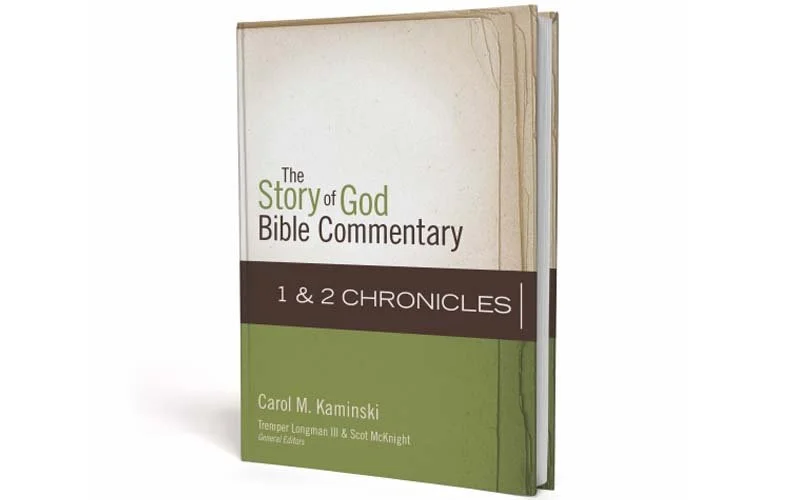 Image 2 of 2
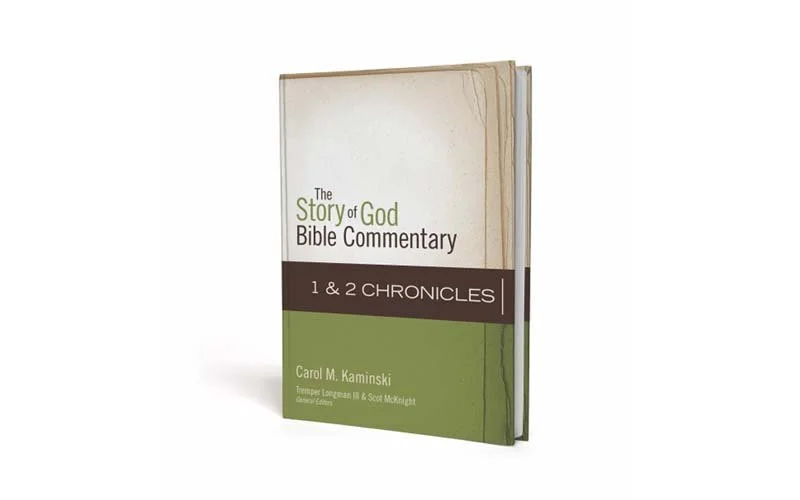
1 & 2 Chronicles: Story of God Bible Commentary
The commentary is available at a discount at Zondervan (we do not sell the commentary on our website). Use the link below to purchase the commentary.
Available at ChurchSource.com
Description:
A new commentary for today's world, The Story of God Bible Commentary explains and illuminates each passage of Scripture in light of the Bible's grand story. The first commentary series to do so, SGBC offers a clear and compelling exposition of biblical texts, guiding everyday readers in how to creatively and faithfully live out the Bible in their own contexts. Its story-centric approach is ideal for pastors, students, Sunday school teachers, and laypeople alike.
Three easy-to-use sections designed to help readers live out God's story:
LISTEN to the Story: Includes complete NIV text with references to other texts at work in each passage, encouraging the reader to hear it within the Bible's grand story
EXPLAIN the Story: Explores and illuminates each text as embedded in its canonical and historical setting
LIVE the Story: Reflects on how each text can be lived today and includes contemporary stories and illustrations to aid preachers, teachers, and students
Author: Carol M. Kaminski
Editor: Tremper Longman III
Publisher: Zondervan
Release date: October 2023
“What a gift to the church! Kaminski draws us into the sacred story of God’s kingdom in the life of post-exilic Israel and helps the church see this same story continuing in our world today. With an engaging style, clear explanations, and rich theological insight, Kaminski has produced the go-to resource for pastors and Bible Study leaders who aim to savor 1–2 Chronicles and lead others to do the same.”
—Andrew Abernathy, professor of Old Testament, Wheaton College
“Kaminski masterfully keeps the theology and purpose of these books always in view. Instead of getting lost in the details, she shows how they are like brushstrokes that paint a glorious theological vision for God’s people. She also shows how that vision is equally necessary for God’s people today, making this commentary theologically rich and practically oriented. What a help for preachers and teachers!”
—Jay Sklar, VP of Academics and professor of Old Testament, Covenant Theological Seminary
“Carol Kaminski's commentary on Chronicles is a wonderful gift to the church. Her reading of the book is historically aware, literarily sensitive, theologically informed, and pastorally astute. Chronicles has often been neglected in the church, but need be no more.”
— David Firth, tutor in Old Testament, Trinity College, Bristol
“Composed to reassure God’s followers in a time of instability and uncertainty, the books of Chronicles offer hope that God’s purposes will be fulfilled, while at the same time reminding the people of the importance of praying with humility. Drawing on the best of recent research, Prof. Kaminski’s commentary on Chronicles is an accessible and judicious explanation of the text that helpfully addresses its relevance for modern readers. Bible readers interested in Chronicles will undoubtedly find this to be an exceptionally valuable resource.”
—T. Desmond Alexander, senior lecturer in biblical studies and director of postgraduate studies, Union Theological College
1 & 2 Chronicles Commentary
Review by Peter H.W. Lau
Chronicles is an oft-neglected book in the church, so a new commentary that shows its theological and pastoral relevance is a welcome contribution. Carol Kaminski, Professor of Old Testament at Gordon-Conwell Theological Seminary, has published two monographs on Genesis as well as an eight-week Bible study on 1–2 Chronicles. Her volume appears in the Story of God Commentary series, which uses the NIV (2011) and is aimed primarily for clergy and laypeople. Like other volumes in the series, the commentary seeks not only to explain the text in its original setting but also to identify historical, typological, and theological trajectories that “land in Christ in the New Testament” (p. xvii).
The commentary begins with a concise seventeen-page introduction, covering standard matters. Issues of authorship and date are followed by discussions of canonicity and title, genre, literary structure, and historical setting (pp. 4–13). Kaminski also includes a brief section on preaching from Chronicles, where she suggests that a topical approach is best, highlighting themes such as prayer, worship, or leadership principles (p. 8). Churches that preach through a book systematically would have appreciated guidance on chapter clusters. The introduction concludes with theological themes: a vision for a unified people of God, a vision for a worshipping people of God, a vision for a prayerful people of God, and a vision for a witnessing people of God (pp. 13–17). The last theme is particularly noteworthy—a brief discussion of the passages related to God’s mission beyond Israel, a theme often neglected in readings of Chronicles.
Following the design of the series, the commentary proper examines each chapter in three stages. “Listen to the Story” presents the whole chapter under consideration along with a list of relevant earlier Old Testament texts. This section functions as a canonical orientation rather than a close analysis of the type and degree of innerbiblical connections. For that type of discussion, consult Gary E. Schnittjer, Old Testament Use of Old Testament: A Book-by-Book Guide (Grand Rapids: Zondervan, 2021). “Explain the Story” discusses the passage section by section, typically in two or three pages, with footnotes used sparingly. “Live the Story” applies the passage to contemporary Christian audiences. The volume concludes with Scripture, subject, and author indices.
Several features make this commentary a valuable resource for its intended audiences. Kaminski consistently prioritizes the Chronicler’s presentation rather than reading Chronicles as a supplement to Samuel–Kings. This approach allows Chronicles’ distinct emphases, such as the centrality of the temple, worship, and God’s promise to David, to emerge. The commentary also reads from the perspective of the whole storyline of the Bible, where the Old Testament is integral to the unfolding biblical narrative, continuing through to its New Testament fulfillment.
Kaminski’s integration of ancient Near Eastern historical and cultural background is another strength. References to material remains, inscriptions, and comparative data are used judiciously to illuminate the text. For example, Kaminski notes that the archaeological evidence of horse stables at Megiddo dates to the ninth century BC, which is later than Solomon’s time, but still points to the “kind of infrastructure required for Solomon’s many horses and chariots” (2 Chr 8:6; p. 348).
The applications are generally thoughtful and pastorally orientated. Kaminski regularly grounds contemporary reflection in the New Testament rather than moving directly from Old Testament text to modern Christian practice. This approach reflects the series’s commitments and will be appreciated by readers concerned with canonical coherence.
Only a couple of observations may be offered by way of critique. First, given the theological significance of the Chronicler’s change of phrasing in 1 Chronicles 17:14, where God says that David’s son will be “set over my house and my kingdom,” further discussion of its implications would have been welcome (pp. 180–81). The Chronicler’s presentation of the inseparable link between temple and kingship raises important interpretive, theological, and perhaps even messianic questions.
Second, some Themelios readers may desire a more explicit christological trajectory in certain applications. In the discussion of Josiah (2 Chr 34), Kaminski suggests that the king’s example reminds readers that “God uses people of all ages—including youth—for his kingdom purposes,” supported by 1 Timothy 4:12 and 2 Timothy 3:14–15 (p. 551). Another possible biblical-theological trajectory is to situate Josiah’s reforms within the Chronicler’s tension between outward covenant renewal and the persistence of judgment. Huldah’s prophecy reveals that even exemplary reform cannot avert disaster on Jerusalem and its people (2 Chr 34:25–26), highlighting the need for a more decisive and enduring renewal. From a canonical perspective, Josiah’s youthful zeal for the temple and the book of the law may thus anticipate Christ, whose perfect obedience and covenant mediation accomplish what royal reforms could not (cf. Luke 2:40–52; Heb 10:5–14).
These observations are relatively minor and do not substantially detract from the commentary. Kaminski has produced a readable and theologically engaged commentary that meets the series’s stated aims. The commentary is a valuable addition to the expanding stable of Chronicles commentaries from a pancanonical perspective. Themelios clergy and laypeople can add this commentary to consult, alongside recent commentaries with a biblical-theological bent, such as John W. Olley’s “1–2 Chronicles” (in ESV Expository Commentary, ed. Iain Duguid, James M. Hamilton Jr., and Jay Sklar [Wheaton, IL: Crossway, 2019], 3:899–1294) and Graeme Goldsworthy’s 1 and 2 Chronicles (Sydney South: Aquila, 2021).
Themelios Vol 51, Issue 1, May 2026, available at the Gospel Coalition